After Uranus castration by Saturn that allowed the Titans to rule the Cosmos, Gaia (the Earth) laid with Pontus, the pre-Olympian god of open sea, to bring into life many of the divine creatures of the water. Two of their children, Phorkys and Keto, had the three Graeae (Greek for old women) who were old and shared one eye and one tooth amongst themselves. They also had Scylla and Charybdis, and eventually the three Gorgons. The most famous amongst the Gorgons was the mortal one, Medusa, known for the story of her death by Perseus.
Different ancient sources present varying descriptions of Medusa. According to Hesiod’s Theogony, Medusa, along with her sisters, was depicted as a monstrous being whose terrifying visage could turn people to stone.
Centuries later, the Roman poet Ovid retold the tale of Medusa in his poem Metamorphoses, adding a twist: Medusa wasn’t always a monstrous figure but a stunningly beautiful woman, the most beautiful one amongst her Gorgon sisters. Her alluring beauty attracted many admirers, causing quite a stir among them. Those who beheld her were struck by the contrast between her captivating beauty and her piercing gaze. Yet, it was her long, golden hair that truly mesmerized them, flowing in elegant waves and shimmering in the sunlight.
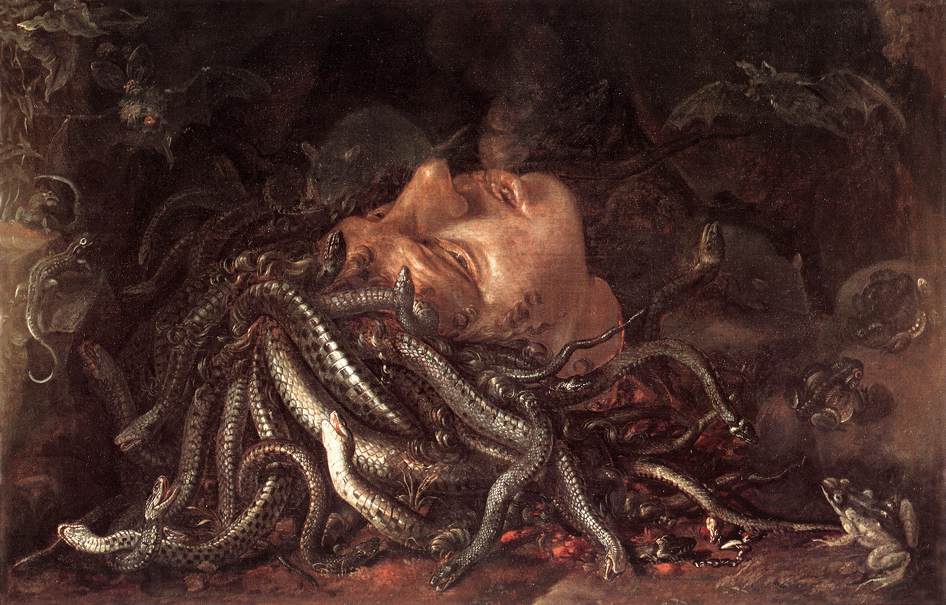
Head of Medusa
16th century
Perseus and Medusa
The journey of the demigod hero Perseus intersects with that of the monstrous Medusa through a daunting challenge that Perseus bravely undertook. It was more like a suicide mission, a desperate attempt to remove him from the picture, as Perseus stood as an obstacle to King Polydeuces’ devious plans to marry Danae, Perseus’ mother. Using the pretext of a wedding gift to a Peloponnesian princess, the head of a Gorgon was asked.
The stunning beauty of Medusa inevitably caught the attention of the Olympian gods, particularly Poseidon, who became infatuated with her. However, their encounter took a tragic turn. Poseidon, in a cruel act, assaulted Medusa within the sacred confines of Athena’s temple, rapping her. Enranged by this violation and being afraid of provoking Poseidon’s wrath, Athena punished Medusa instead by transforming her lovely locks into venomous snakes, turning her into a monstrous being whose gaze now petrified all who looked upon her. Ovid’s myth portrays Medusa as a victim rather than a villain, emphasizing the consequences of her rape and the desecration of Athena’s sanctuary.
And just like that, a monster was born.
With the blood of the gods in his veins, Perseus received assistance from Athena and Hermes for his mission to find and slay Medusa. They provided him with special tools: a strong sickle, winged sandals, an invisibility cloak, and a pouch to hide Medusa’s head. Upon reaching the Western Oceans, where the Gorgons lived, Perseus, avoiding eye contact with Medusa, used a bronze shield as a mirror to decapitate her successfully.
Like in all myth tales where half-god heroes get into deadly tasks by wicked rulers, Perseus also got the girl in the end. On his journey back, he saved Princess Andromeda, who was chained to a rock, moments away from becoming sacrificial food to Cetus, the sea monster. The petrifying gaze of Medusa’s head ensured that even a glance from Cetus would meet its demise. The Medusa’s head was ended up on the god Athena’s shield, a powerful weapon against her enemies.
The Symbolism of the Myth
In an attempt to approach the symbolism of Medusa, we must take a closer look at her origins to understand her essence. Descended from Pontus, the embodiment of the vast sea, and Gaia, the embodiment of the earth, Medusa brings close the salt water of desire with the lifeless substance of the matter. A woman who was once captivating and enchanting because of her beauty, able to allure the men, has now transformed into a ghastly and terrifying monster, petrifying them into stone. Symbolically, Medusa embodies the captivating pull towards the desire for the matter.
As the eyes are symbolically the entrance to a man’s soul, it is only through Medusa’s gaze that people become stones, being trapped forever in a lifeless state of matter. When one chooses to be seduced by Medusa’s eyes, following her gaze, the soul perishes while the body turns to stone. Choosing to follow the desire to pursue the matter, you become part of it, forever preventing the soul from rising above.
Then the hero comes, Perseus.
In Greek mythology, heroes are frequently portrayed as demigods or highly skilled humans, presenting numerous virtues manifested through their deeds and actions. They embark on grand adventures where they confront daunting obstacles along the way of their epic quest. These obstacles are hideous monsters that must be confronted and defeated in order the goal of the hero to be fulfilled. A hero represents the better versions of one’s self, and his or her journey to a task symbolizes our way towards inner-growth and completeness. To get to the finish line the road is harsh as we need to confront the “monsters”, the evils in our worlds, all the unpleasantness of life that demands confrontation for our souls to rise.
Perseus is a demigod hero. He’s part mortal, part divine, presenting our dual nature. With the help of Athena, the goddess of wisdom and logic, he defeats Medusa. It is only through the use of wisdom and clear thinking we can help ourselves to go against the alluring pull of the desire for the matter. Wisdom is the only tool to resist the temptation of the desire, which otherwise could turn us into soulless beings. Perseus avoids being turned to stone by Medusa’s gaze by looking at her reflection in a bronze shield. Stepping back, and see things from a perspective other than ourselves (wisdom) we can cut off Medusa’s head. Only then we can contain it, like Perseus did when he put Medusa’s head in the pouch. Finally, he escapes from the Gorgon’s world using Hade’s invisibility cloak and Hermes’ winged sandals, pointing to the lack of form and solidity as the means to find freedom.
Algol – The Medusa’s Head
Algol (of Saturn and Jupiter nature according to Ptolemy) is the brightest star in the Perseus constellation placed on the head of the Medusa and considered to be as the most malefic one. It is important to understand that Algol is an eclipsing binary star system, where one star crosses in front of the other, causing fluctuations in brightness (as we look at it from Earth). This eclipse-like quality contributes to Algol’s connection with loss and extreme malevolence. After all, where there is no light, there is no knowledge nor life.
Algol’s placement on Medusa’s head has an important role to its symbolism. The head serves as the command center of our existence. It houses the brain, the organ that governs all the functions of the body, the seat of consciousness and control. If we remove the head, just like Perseus beheaded Medusa, it leaves the body devoid of control. In this way the body is driven solely by desires.
Metaphorically, Algol embodies the essence of decapitation – a blunt and violent force that cuts off the link between the head, the wisdomx and the body, the operational apparatus, leading to irrationality and loss of control. In practical terms it signifies fuzzy thinking, difficulty to have a clear picture of a given situation and bound to material pleasure. When the head, which contains the faculties for perceiving and engaging with the world, is cut off, one is left with a body lacking sight and the ability to apply wisdom.
Since the head sustains the body, Algol’s association with loss and death is evident. Its placement on the monstrous Gorgon’s head also ties it to deformity and ugliness.
When Algol features prominently in a horoscope, it prompts a reality check. Like Perseus, one must step back and reflect, using wisdom to resist the allure of temptation. The choice is clear: surrender to desires and remain bound to material concerns losing your soul or use the sword of wisdom and free yourself by cutting off the monster’s head.
Cosmologically speaking, nothing is inherently evil. We can either wield Algol’s power to our advantage or fall victim to its influence. Just as Perseus used Medusa’s head to vanquish other monsters, like he did with Cetus, and just like Athena used it to strike fear into her foes by placing it to her shield, we too can either use Algol to seduce the world or to cut off the head of our adversaries. The key is to never catch Medusa’s gaze.
Versace – The Head of Medusa
Perhaps one of the most widely recognized symbols of Medusa is the one featured in the company logo of the luxury fashion brand Versace, founded by Gianni Versace. Below is Gianni Versace’s horoscope. Please, mind this is not a comprehensive interpretation of a part of his life, but rather a concise exploration of the symbolism associated with the fixed star in question.

Reggio di Calabria, Italy
It is quite surprising that Algol, the fixed star placed in Medusa’s head is emphasized here by conjuncting the 7th house cusp in Gianni Versace’s horoscope. A fixed star on the cusp of an angular house would always hold a significant meaning in that person’s life. It connects the myth of the constellation the fixed star belongs to, manifesting it in the individual’s life in some way or another.
The Descendant is the person’s getaway to the world, pointing to the way we relate with others.
We could say that in a practical level, Gianni Versace’s way of relating with the world was influenced by the myth of Perseus, and in this case, because of Algol’s presence, quite literal with Medusa’s head. This mythological significance played a role in how he interacted with others, and also how the world perceived him: in a glamorous and alluring way. This is a powerful position for seducing others or being seduced by them.
The myth of Medusa carries a straightforward caution: indulging in desires can lead to dire consequences. With Algol positioned on the Descendant, there’s a clear message to approach relationships with wisdom, avoiding the temptation of materialistic connections with the world, as the price to pay could be high. If the claims were true regarding Giovanni Versace’s connection to 27-year-old Cunanan, a college dropout, with psychological and drug issues, a dark sexual history of working as an escort for wealthy men and eventually a serial killer, Algol’s position would be a clear warning against such materialistic relationships.
This caution is particularly emphasized due to the challenging placements of the planetary energies associated with Algol: Saturn in its detriment and Rx and Jupiter peregrine pushed away inside the 12th house. As a result, Algol in this context tend to lean towards the unfavorable.
 The Classical Astrology