Prince Leopold of Albany was the eighth child and youngest son of Queen Victoria and Prince Albert. His sharp intellect, charming and sociable character, and thirst for life made him one of the most intriguing members of the royal family. Despite his royal status, he struggled with health problems throughout his life, particularly hemophilia, which made even minor injuries potentially life-threatening. Unlike his traditionally military-minded brothers, he did not have a full military career, which was unusual for a British prince at the time. However, he played an important role as an advisor to his mother, Queen Victoria, and was known for his diplomatic skills despite his young age and fragile health. He was also the first British prince to study at a university, as royal education typically consisted of private tutors preparing princes for military service or diplomatic roles. Later, he became Chancellor of Oxford University, further cementing his commitment to academic pursuits.
Leopold’s curious and adventurous spirit, along with his deep thirst for knowledge, allowed him to form connections with scholars and thinkers from around the world. Despite his hemophilia, he traveled across Europe and the Mediterranean, eager to experience different cultures and broaden his understanding. Unfortunately, one of these journeys cost him his life—he suffered a fatal injury in Cannes, France, at the young age of 30. His life, though full of intellectual and social accomplishments, is also significant in medical history. As one of the earliest documented royal cases of hemophilia, his condition played a major role in scientific research on the hereditary nature of the disease. His case helped medical researchers understand how hemophilia was passed down through generations, particularly in European royalty, where it became known as the “Royal Disease.”
In this article, we will explore Prince Leopold’s horoscope through the lens of traditional medical astrology to understand how his health vulnerabilities are reflected in his birth chart. As we often mention, traditional medical astrology is a specialized branch of astrology with its own unique philosophy, which can stand independently as a complete system. Once again, it’s important to note that the language of traditional medicine differs from that of modern medicine. Despite the efforts by our modern cousins to blend modern medical concepts with traditional astrological philosophy, these attempts have largely been unsuccessful and they do not work in practice. Traditional medical astrology follows its own distinct principles, separate from modern medical approaches.
Our modern cousins, when trying to assess a person’s health through the horoscope, go straight to the 6th house of “health.” This approach is fundamentally mistaken and a misinterpretation, stemming from the attempt to integrate modern concepts into traditional astrology. First of all, there are earlier stages in the chart that need to be evaluated. Secondly the 6th house is not the house of heallth but the house of the various evils life serves us, of which illness is only a part.
First and foremost is the temperament—the kind of fabric from which a person’s being is woven and everything in the chart is filtered by it. Ideally, there should be a balance of the elements (referred to in this context as humors) within the temperament. However, there are often extreme cases where one element dominates, and this leads to problems that manifest not only on the physical level, in the body, but also extend to the emotional, mental, and spiritual levels.
Prince Leopold’s temperament is far from balanced, being choleric—the choleric humor corresponds to the element of fire (cholerics have piercing eyes, look at Prince Leopold’s sharp eyes!). Such an extreme imbalance opens widely the door to afflictions, making his physical constitution particularly sensitive and prone to illness. While this excess of fire can predispose the body to what traditional medicine classifies as “choleric” or fire-related diseases, that’s not always a direct outcome. Although hemophilia is traditionally a blood-related (Sanguine) disorder, excess of other humors can also contribute to it. In the case of an excess of fire may “overcook” the blood, thinning it or breaking down its cohesion, leading to easy escape through tissues and impaired clotting. What is important to understand here is that an imbalance in the temperament can make the organism valnurable, and this is something that we must address through balancing it.
Since the body is only one part of human existence, an excess of the fire element inevitably extends into other realms, particularly the psyche. Fire, being the element of pure action, possesses a caustic, rising, and penetrating nature. Psychologically, it often expresses itself as restlessness, impulsive initiative, boldness, courage, and a drive to lead or to break new ground. There is often little patience for detail or deliberation—quick, instinctive action tends to dominate, with consequences sometimes left for others to manage. This can lead to a reckless attitude and result to accidents.
In Prince Leopold’s life, his choleric temperament is not just theoretical—it is vividly illustrated in the historical record. His boldness, drive, and will to take risks were notable traits, as was his determination to assert himself despite the limitations of his fragile health. He pushed boundaries, resisted a passive role, and sought active engagement with life, often with a fiery intensity that matched the temperament written in his chart.
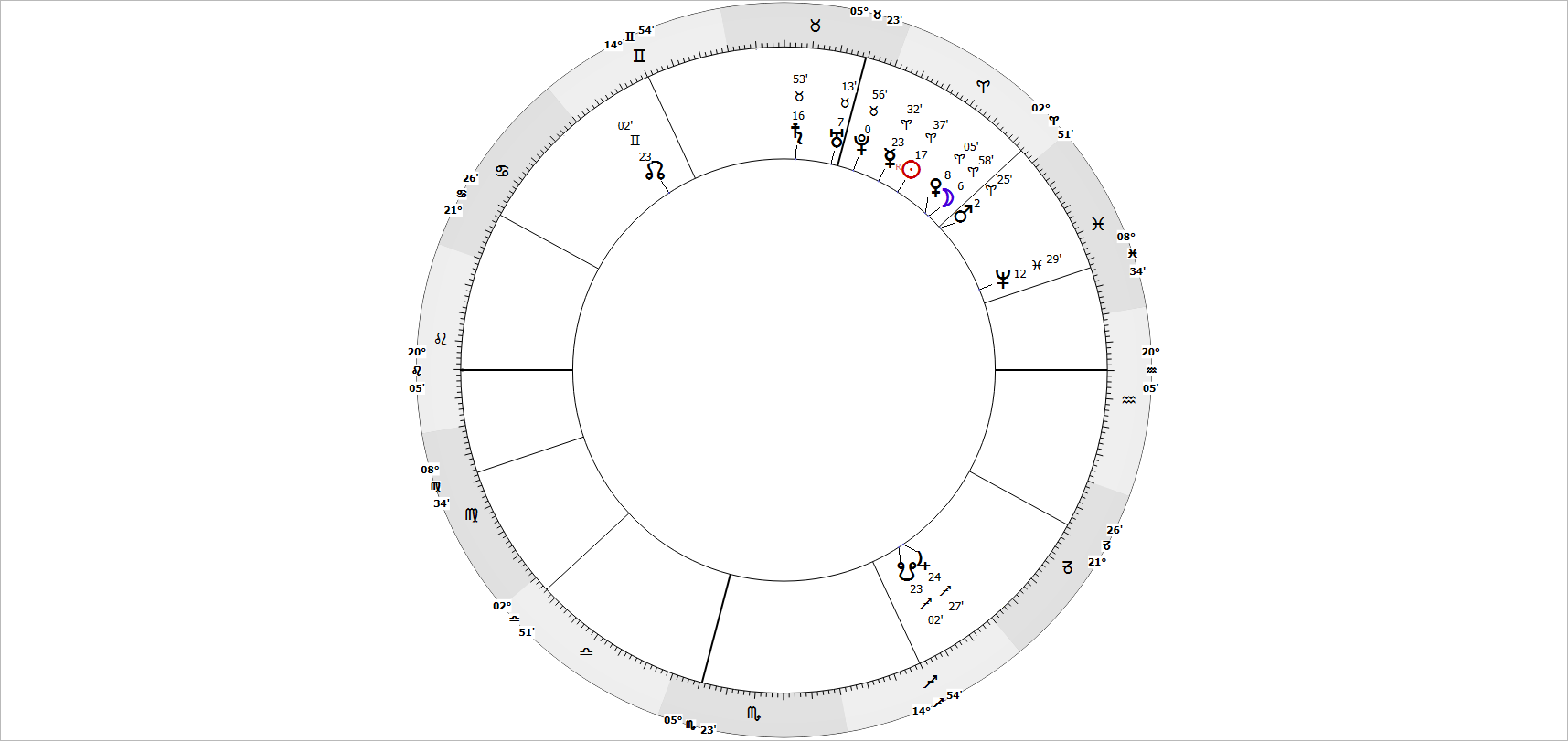
Now let’s look at his horoscope and ask ourselves: What really stands out there?
Yes, certainly, it’s the concentration of planets in the 9th house—the house of ideas, higher knowledge and politics—and the fact that all these planets are ruled by Mars, the planet of action, two key points in his life. However, there’s something else equally striking: five out of the seven traditional planets are placed in Saturn’s fall, indicating a letdown in its expected function. Saturn is the only planet in Prince Leopold’s chart that is placed in an angular house. This gives it the power to manifest itself with great force in his life, making its influence especially important. And what is Saturn in his chart? One of the things Saturn rules is the 6th house—the house of all those poisoned arrows life sometimes throws at us in the form of misfortune, accidents and, of course, illnesses.
Saturn, the Great Malefic and natural significator of boundaries, barriers, and limits, is peregrine in Prince Leopold’s chart. In this condition, Saturn’s function does not operate as it supposed to do. Actually, the Great Malefic is going to show its worst side. Saturn struggles to establish proper barriers—they are either too weak and dissolve easily or become overly rigid and suffocating. Being L6 of the illness it may indicate that the saturnian energetic stream within Leopold’s body is “diseased.” Saturn plays a crucial role in building dense, solid structures and masses within the body, and in the case of hemophilia, this process fails: blood clots cannot form properly to stop bleeding. Leopold often suffered from bleeding in his joints, frequently causing knee pain that made him rely on a cane. In his chart, this links to the weak Saturn, which naturally rules the joints, affecting with its presence the 10th house—the anatomical area connected to the knees.
A disturbed Saturnian energy can manifest in various forms if given the opportunity, and in Prince Leopold’s case, we interpret it within an already established context. What is important to understand is that, against the backdrop of an unbalanced fiery temperament, a weak and extremely cold Saturn, L6 of illness can emerge with significant force, causing considerable trouble, especially as the only planet placed inside an angular house. Within this fiery imbalance, the weak Saturn could have begun to manifest its illness effect very early in Leopold’s life.
The weak Saturn, symbolizing harsh restriction and placed in the 10th house of public role, offers a clear indication of how illness hindered Prince Leopold from fully assuming his public duties. In another way, Saturn of restriction is found inside the 10th house of the mother: Queen Victoria was deeply protective and often restrictful of Prince Leopold due to his hemophilia. She limited his independence, fearing for his safety, and resisted his desires for autonomy and marriage. He wrote letters expressing frustration with her control.
Back to our astrology, the Sun and Moon, the two Luminaries, are primary sources of our vital energy. The Sun, as the dominant life force, channels its energy into the earthly realm through the Moon. When afflicted, the Luminaries disrupt the natural flow of this energy, like a short-circuit in the system.
In Prince Leopold’s chart, the Sun is the ruler of the 1st house and significator of the body, essentially dignified—exalted, in its triplicity, and in the house of its Joy—indicating a strong vital force. Positioned in the 9th house, the house of long journeys, the Sun thrives, reflecting the importance of travel in his life. Notably, many of his journeys were therapeutic, undertaken to escape the cold, damp British climate. The mutual reception with hot Mars, Lord of the 9th, points to the beneficial effect of warmer and drier foreign climates on his body. Warmer climates could relieve the symptoms of the but not the cause. However, L1’s good condition is not without complication: the Sun is conjunct Baten Kaitos, a malefic saturnian fixed star on the Belly of the Sea Monster, symbolizing imprisonment and restriction. Furthermore, the Sun’s antiscia opposes Neptune, the Earth-Shaker, adds a subtle destabilizing influence, suggesting the vulnerability of the physical body when it is being led by desires or chaotic factors. A shock-like quality that brings tension the body.
The condition of the other Luminary, the Moon, is far less favorable. Weakened under the Sun’s beams, the peregrine Moon conjuncts Venus in her detriment. This marks a fragile luminary condition. What, then, causes the Moon’s light to flicker? Venus rules the 3rd house of daily life and the 10th house of career or public role, suggesting that matters relating to daily routines and the public role weigh heavily on the vitality reflected by the Moon.
The Moon, as dispositor of the Part of Illness (Asc + Mars – Saturn for diurnal charts), reveals where suffering takes root in life, which part of it is the disease. The Part of Illness forms a square to its weak dispositor, indicating that Prince Leopold’s illness is connected to a disrupted lunar energy stream, expressed in the physical level as a dysfunction in fluidity. As ruler of the 12th house of isolation and restriction, the Moon ties the illness to imprisonment, which also negatively affects Venus by reception—the ruler of his daily life (L3) and public role (L10).
Up to this point, we have seen that Prince Leopold’s horoscope contains several warning indicators that strongly suggest the likelihood of a particularly vulnerable physical constitution, as well as a high probability of illness. At this stage, our modern counterparts might stop. However, traditional medical astrology is only just beginning—through its preventative practices.
Our primary goal is to manage the excess of the fire element in Prince Leopold’s temperament. This can be approached in various ways: through diet, the careful use of herbs (always under proper guidance), lifestyle adjustments, or even with tools such as gemstones, metals, colors, and music. With so many resources at our disposal, we can bring balance to a disrupted temperament—especially during periods when predictive astrological techniques warn us of heightened fire-related imbalances.
To temper the excess of fire, we may use traditionally cold and moist foods—such as light beers, milk, salads, or even some juices—when medically appropriate. Contact with the water element also helps to restore balance. While competitive sports typically help release fire, they would be unsuitable in Prince Leopold’s case. However, assertive behavior can serve as a safe psychological outlet for excess fire. In contrast to Queen Victoria’s approach of strict control, attempting to suppress fire only worsens the imbalance—fire must be expressed in a proper and constructive manner.
On a second level—the planetary level—what needs to be addressed is the most evident issue in the chart: the weak Saturn. To support or neutralize the saturnian energy, we can apply either sympathetic or antipathetic planetary energies: through sympathy planets can harmonize Saturn and reinforce its function while through antipathy planets can have a counterbalancing effect to Saturn. This must always be done through the lens of what the horoscope allows—sometimes the solution is clear, other times is more subtle. In Prince Leopold’s chart, we have three strong planetary candidates: the Sun, Mars, and Jupiter. However, only Jupiter offers an optimal energy stream. Despite its conjunction with the diminishing South Node, Jupiter remains essentially strong and, unlike the Sun and Mars which both are in Aries thus receiving Saturn through its fall and eventually harming it. Jupiter has an opossing energy to Saturn’s. As an Air planet, Jupiter can soften Saturn’s rigidity, offering a balancing influence. Furthermore, being the planet of blood, Jupiter can support the “bad” blood in his body while at the same time can support L1, the body through reception by triplicity. An excellent jupiterian herbal choice is Sage (Salvia officinalis), which can be burned or kept close to the body. Tin, Jupiter’s metal, is also beneficial and may help reduce Saturn’s harshness when worn or kept nearby.
 The Classical Astrology