
I was coming back home from work when my phone rang. It was my friend B. — and since our late-night conversations had slowly turned into a kind of unofficial ritual, seeing his name flash on my screen at 11 p.m. was not exactly a plot twist.
“Hey, what’s up ?” I asked, digging through my backpack for my keys.
“One of those days…” he sighed. “I had a huge fight with my manager.”
“Man… again?” I said, not because I was shocked, but because the last episode was still practically warm.
There was a short pause. Then he continued, in that low, wounded tone people use when they already know the other person may have a point.
“And this time he told me I should see a specialist about my bursts of anger.”
Now, I love my friend, but honesty is also a form of friendship.
“Well… he is not entirely wrong,” I told him. “You catch fire from the smallest spark. Your boss, your clients, your friends, your parents — somehow everyone gets a guest role in your personal war movie.”
“I know… I know…” he replied.
And the truth is, B. really is a walking ticking bomb with excellent social skills until someone accidentally presses the wrong button. The smallest inconvenience can become a battlefield; a harmless comment can turn into a declaration of war. For whatever reason, he often seems to be in a permanent argument with the world — and the world, unfortunately, keeps answering back. Until that point, I had never seriously looked at his natal chart. But after that conversation, curiosity won. A few days later, I asked him for his birth data. Naturally, because the universe enjoys comedy, he did not know his exact birth time. We had a lovely forty-minutes window of uncertainty, which meant I had to leave aside time-sensitive points or techniques such as house cusps on the brink of changing signs and lots, and focus instead on the broader picture. And sometimes, the broader picture is already loud enough.
Luckily, the forty minutes of uncertainty did not change the Lord of the Ascendant: Mars, the natural planet of aggression and tension is B. in the life and this is exactly where the story begins to get interesting.
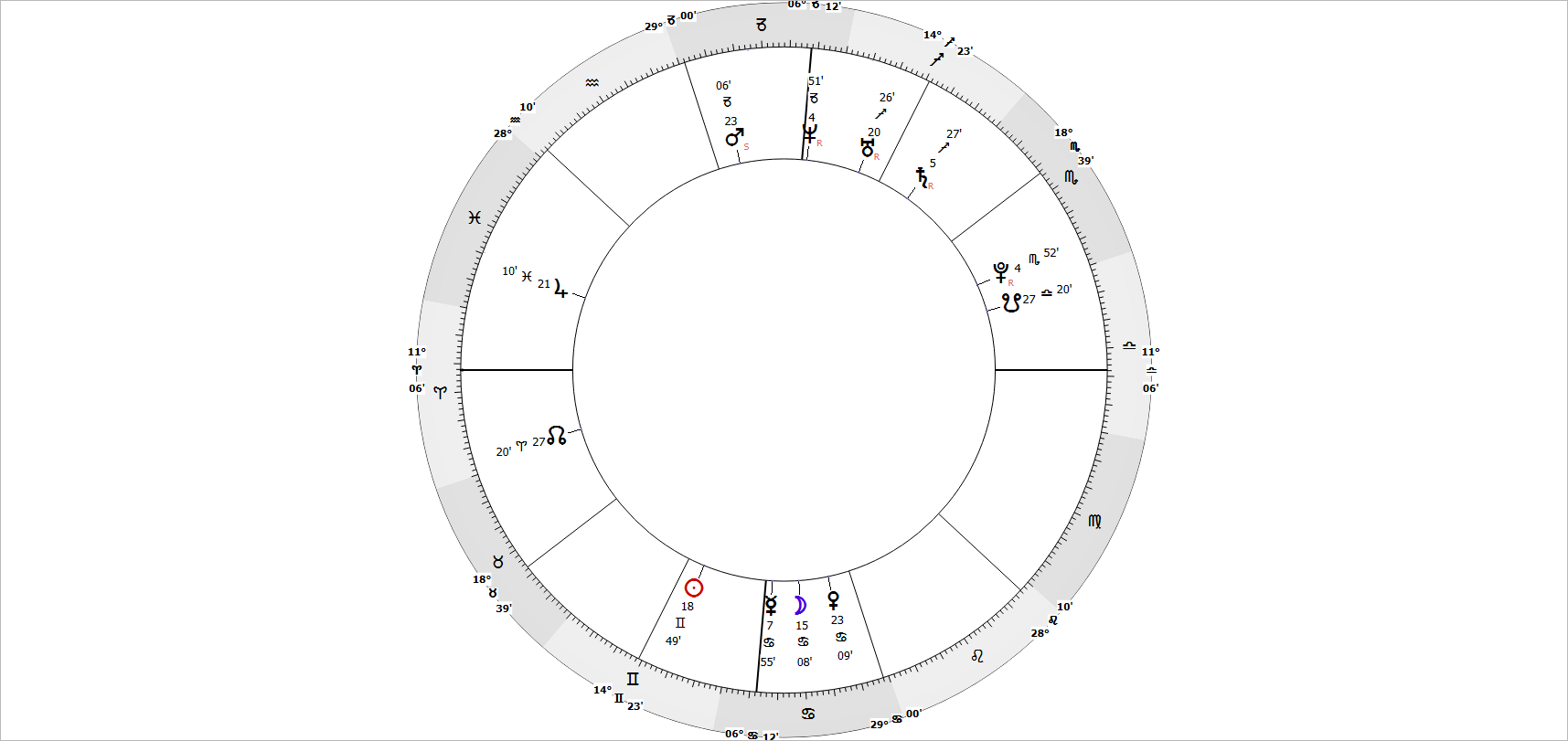
In his chart, Mars is in the cardinal sign of Capricorn, the sign of its exaltation, and the most elevated of the seven traditional planets. With L1 being in its exaltation it suggests that “I” is placed very high up there, so Mars’ priority is Mars itself, a not very positive sign when it comes to relationships. But when this exalted Mars is also placed in the higher place of the horoscope, the 10th house of one’s throne in life, Mars is not just in the room making its assertive nature present, it has quickly taken the chair at the head of the table.
The way one relates to the world falls under the 7th house: it reveals the potential blueprint of the “how-to manual” one is made of when it comes to engaging with the world, whether we’re talking about a significant other, a client, or that colleague. Since the birth time window places the Descendant in Libra, two major things happen: L7, is Venus in Cancer and the South Node is placed inside the 7th house.
The natural ruler of unity, placed in the cardinal waters describes how B. relates to the world. Venus, in her own Term, is not especially strong here, since this is only a minor dignity. This suggests that his way of connecting with others may carry a pleasant and unifying quality, but not necessarily depth or real substance. Venus in Cancer becomes fluid and passive, making relationships less stable and more subject to the shiftiness of the cardinal water. Yet, Venus is ruled by an essentially strong Moon, so Venus’ weakness is moderated rather than left unchecked.
With Venus, L7 of others, opposing L1, B., conflict with other people becomes a strong potential in his life. This does not mean that every relationship is automatically hostile, but it does show that one-to-one encounters can easily activate tension, resistance, or open opposition. The opposition brings the two planets close together creating the contact, but it then results into separation. Here, the receptions do not help to soften the dynamic. Mars, in its own Exaltation and Term, is not interested in Venus. Venus, in turn, is in Mars’ Fall, showing dislike, rejection, or disdain toward whatever Mars signifies — in this case, B. The result is a clear potential for collision: the aspect may pull B. into contact with others, but that contact can quickly become a field of conflict and opposition.
It is important to note that the chart points to the possible involvement of the 12th house ruler in matters of relationship. Because the birth time is unclear, we cannot be certain whether Jupiter or Saturn is L12 (there is a 12th house cusp change within the range of the given birth time). However, both planets are still tied to Venus, L7: Venus is in mutual reception with Jupiter, and she opposes Saturn by antiscia. So, rather than forcing certainty where the time does not allow it, we can stay with the broader picture: Venus values what Mars rejects (Jupiter), and Mars values what Venus distastes (Saturn). This makes relationships more than a simple field of conflict. They also seem to work against what B. values or seek most in life. The involvement of Saturn sharpens this point. Saturn, being peregrine, can describe misery, deprivation, and the loss of solid ground. Since Venus opposes Saturn by antiscia, the absence of “solid ground” or “boundaries” that B. seeks creates tension to the way he relates to others concerning his relationships.
Approaching the chart without considering factors such as the Seven Arabian Parts, Antiscia, Fixed Stars, Lunar Mansions, and Receptions can leave part of the picture missing. However, not all of these factors can be used with the same confidence here. The Parts, for example, are highly time-sensitive, so with an unclear birth time they should be handled carefully or avoided. Fixed Stars, on the other hand, can still be useful, especially when they touch a sensitive point in the chart, a planet.
Venus, conjuncts Pollux, the brightest star in the Twins’ constellation. In mythology, Pollux was the immortal twin, while Castor was the mortal one. The Dioscuri were associated with boxing and horse-taming, and in one of their battles, Castor was killed. Their myth captures the essence of the struggle being caught between two poles: Pollux, the divine and immortal principle, and Castor, the mortal and material one. Although Pollux, as one of the royal fixed stars can bring great success and distinction (in this case success may come through partners), its symbolism still carries conflict and polarity. Since this royal fixed star touches Venus, L7 of relationships, it reinforces the larger theme already present in the chart: relationships are marked by opposition and the recurring tension between union and separation.
Within the given birth-time frame, the Nodes remain tied to the 1st/7th house, again underlining how central relationships are in B.’s life. Symbolically, the Nodal Axis is an unbreakable line of passage: the North Node, Jupiter-like, shows where the soul enters and expands, here things come effortlessly; the South Node, Saturn-like, shows where it exits, and loses, the place that demands effort. In B.’s chart, the North Node in the 1st house magnifies the self: the pull to become more fully “I”. But opposite it, the South Node in the house of others casts its colder shadow over relationship, bringing limitation, restriction, and pain. So, the point is clear: the more B. is pulled toward himself, the more relationship becomes the place where something is lost, so the difficult place where the real work must be done.
To conclude, even without an exact birth time, the chart still speaks. In B.’s case, three separate testimonies repeat the same message: relationships are not a side theme, but one of the most dramatic forces in his life. Of course, a time range limits certainty, especially with angles, houses, and very time-sensitive points. Still, careful delineation can draw out useful information, provided the astrologer is clear about what is firm and what remains less certain. As always, astrology does not cancel free will. It describes the conditions given in the chart. The client’s task is still to choose as wisely as possible within those conditions.

