
According to traditional cosmology, the world and everything contained within it are understood through the four elements: Fire, Earth, Air, and Water. Living beings — such as humans, animals, plants, and other organisms — as well as inanimate things, including metals, stones, minerals, and other substances, participate in these elemental principles in different proportions. Their particular elemental constitution contributes to their nature, their mode of operation, and the way in which they relate to their environment.
At first, it is natural to associate the elements with their most familiar physical forms: Fire with a flame, Water with flowing water, Earth with soil, and Air with the air that surrounds us. In traditional thought, however, the elements are not limited to these visible substances. They are more fundamental principles whose characteristics can appear in many different forms. A candle flame, for example, may be regarded as a physical expression of the principle of Fire because it displays several of its characteristic properties: heat, activity, upward movement, and the capacity to produce change. The flame itself, however, is not identical with the elemental principle of Fire.
The relationship is therefore analogical rather than chemical. Something does not need literally to burn or contain a flame to be described as fiery. It may be associated with Fire because its nature or behavior expresses qualities belonging to that element, such as heat, energetic activity, rapid action, transformation, or a tendency to rise. The same distinction applies to the other elements. Flowing water is a particularly clear physical expression of Water, soil gives a tangible image of Earth, and atmospheric air provides an obvious example of Air. Yet none of these physical forms exhaust the meaning of the element itself. They are visible manifestations through which the underlying elemental principles can be recognized.
Thus, when traditional philosophy describes a person, plant, mineral, substance, or natural phenomenon as fiery, earthy, airy, or watery, it is not making a statement about its literal chemical composition. It is identifying the elemental principles that are expressed through its qualities, behavior, structure, and effects.
The Qualities
Every element consists of two qualities, which determine its distinctive properties and modes of action. The qualities originated in ancient Greek natural philosophy and medicine as an attempt to describe the most fundamental ways in which physical nature acts and changes. From the Greek world, this system passed into Hellenistic and Roman thought, was preserved and developed in the medieval Islamic world, and was later transmitted into Latin medieval and Renaissance Europe. Aristotle was the decisive figure who explicitly reduced the basic sensible differences of matter to four primary qualities: Hot, Cold, Dry, and Wet. Their combinations in pairs produce the four elements.
The Primary Qualities of Hot and Cold
The four qualities do not operate separately or independently from one another, but through two essential pairs of opposing axes. The primary axis is that of Hot and Cold, the axis of the primary qualities. Hot and Cold are active qualities, responsible for producing change and for giving rise to the second axis, that of the secondary qualities, Moist and Dry, which will be discussed later.
The primary qualities are related to levels of energy and activity. Hot initiates movement and therefore corresponds to activity, mobilization, action, impulse, outward expression, and stimulation. As the Hot quality gradually decreases, it gives way to the Cold quality, which is associated with a reduction in activity and stimulation. Movement slows down and energy diminishes. Cold is therefore connected with the settling of activity, rest, and passivity. A simple example can be found in the symbolism of day and night: day is associated with Heat and activity, whereas night is associated with Cold and passivity.
The Secondary Qualities of Dry and Moist
As the Hot quality increases, moisture evaporates, and what remains is associated with the secondary quality of Dryness. The Dry quality is closely connected with limitation and the formation of boundaries. It describes the process by which one thing becomes differentiated from another. When something preserves its distinct form rather than blending with what surrounds it, the Dry quality is involved. The separation produced by Dryness leads to distinction, and distinction establishes boundaries. In this way, Dryness contributes to the preservation of form.
On the other hand, an increase in the primary quality of Cold leads to an increase in the secondary quality of Moisture. The Moist quality allows mixture. One thing can pass into another, combine with something else, or become joined to it. Because Moisture favors mixture, it weakens the maintenance of rigid boundaries. Through joining and softening, distinctions become less pronounced, boundaries begin to disappear, and fixed forms become more difficult to preserve. Moisture softens separations and allows things that were previously distinct from one another to come into contact and unite. Under the influence of the Moist quality, a clearly defined form can lose its sharp distinction. The resulting union encourages mixture and softens boundaries, allowing things to merge and flow into one another.
The Qualities produce the Elements
The four qualities do not appear materially as isolated forces. They become perceptible through combinations, each element arising from one primary and one secondary quality. Heat or Cold indicates the general level and direction of activity, but by itself tells us little about what that activity actually does. The secondary quality, Moisture or Dryness, determines whether things are drawn together or kept distinct. The elements therefore describe complete modes of operation rather than single qualities: Fire is Hot and Dry, Air Hot and Moist, Earth Cold and Dry, and Water Cold and Moist.
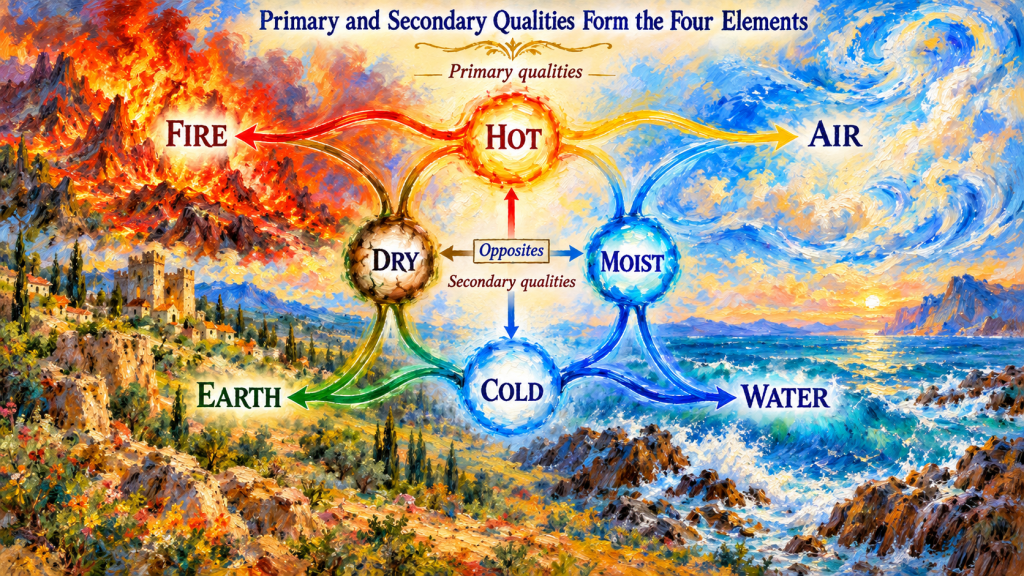
Fire — Hot and Dry. Fire is a light and highly active element. Its Heat produces movement, stimulation and the impulse to act, while its Dryness creates distinction, separation and definition. Fire therefore tends to work by breaking things apart to alter them: it burns, refines, reduces and transforms. The same principle can be recognized psychologically in initiative, assertiveness, competitiveness and the desire to act independently. Fire corresponds naturally with summer, when Heat reaches its greatest strength and gradually removes the remaining moisture of spring. It also fits adolescence and early adulthood, when vitality, independence and the urge to establish oneself become especially pronounced. When balanced, Fire provides courage, activity and transformative force; when excessive, these same qualities can become aggression, impatience or destructive intensity.
Air — Hot and Moist. Air combines the movement generated by Heat with the unifying nature of Moisture. It is therefore light, mobile and expansive, but unlike Fire its movement tends toward connection rather than separation. Air spreads, circulates and passes freely between things, making it a natural image for communication, exchange, sociability and intellectual movement. Its seasonal correspondence is spring, when increasing warmth acts upon abundant moisture and produces growth, fertility and expansion. The same pattern is reflected in youth, a period marked by development, curiosity, playfulness and outward engagement with the world. Blood provides a useful bodily analogy: it circulates continuously, distributing nourishment and vitality throughout the organism. Air can therefore be understood as active connection—movement that joins, carries and exchanges.
Earth — Cold and Dry. Earth combines the reduced activity of Cold with the separating and defining nature of Dryness. The result is density, solidity, limitation and stable form. Whereas Fire separates dynamically through transformation, Earth separates by fixing boundaries and giving things a durable structure. This makes Earth naturally associated with persistence, discipline, endurance, material form and conservation. Its season is autumn, when expansion begins to slow, growth contracts and nature turns toward consolidation. In human life it corresponds especially with mature adulthood, roughly the years in which responsibility, work, limitation and practical obligations become more prominent. Bones, nails and other hard structures offer a clear physical expression of this principle: Earth gives shape and firmness. In balance, it provides stability and perseverance; in excess, it can become rigidity, obstruction or isolation.
Water — Cold and Moist. Water combines the reduced activity of Cold with the cohesive quality of Moisture. It therefore tends toward receptivity, adaptation and union rather than forceful action or rigid definition. Water follows the form of what contains it, flows into available spaces and joins things through contact. Psychologically, this gives it an affinity with emotional attachment, intimacy and passivity. Its natural season is winter, when Heat has withdrawn and Cold and Moisture predominate, while in the human life cycle it corresponds with old age, when physical activity diminishes and softness, sensitivity and dependence often increase. Water nourishes and connects when properly contained, but an excess may overwhelm boundaries, producing stagnation or loss of form. In this sense it stands opposite Fire: Fire acts by differentiation and transformation, while Water works through receptivity and cohesion.
Elements and Traditional Astrology
The four elements have many applications in Traditional Astrology. However, their most extensive use, together with their qualities, is found in Traditional Medical Astrology, which could almost be considered a separate branch of the traditional art. In Traditional Astrology, the four elements are not treated as personality types or simple descriptive labels. Instead, they are an essential part of traditional astrological techniques. This is one of the main differences between Traditional and Modern Astrology. The latter often places too much emphasis on the dominant element in a birth chart, leading to oversimplified conclusions such as: “Oh, you have four planets in Earth signs, so you must be a very practical person!”
Temperament is determined by examining the elemental qualities of several factors in the birth chart, such as the Ascendant, the phase of the Moon, the season of birth and other relevant considerations. There are several traditional methods for calculating temperament, ranging from very simple approaches to much more detailed systems involving numerous factors and calculations.
In Traditional Astrology, temperament is based on the natural balance of the four qualities: Hot, Cold, Moist and Dry. These qualities combine to form the four classical temperaments, each corresponding to one of the four elements: Sanguine (Air – Hot and Moist), Choleric (Fire – Hot and Dry), Melancholic (Earth – Cold and Dry) and Phlegmatic (Water – Cold and Moist). Most people have a mixture of these temperaments, although one usually predominates.
Temperament describes a person’s underlying nature rather than their complete personality. It provides information about their natural level of energy and activity, their emotional responses, their flexibility or resistance to change, and the way they tend to react to their surroundings. For example, a predominantly Choleric person may be naturally active, quick to react and easily irritated, while a Phlegmatic person may be slower, calmer and less inclined to immediate action. Temperament is the basic material from which a person is made, not everything that person will become. The rest of the natal chart must therefore be interpreted in relation to this underlying constitution. Two people may have similar planetary placements but express them differently because their temperaments differ. Temperament never changes.
In Traditional Medical Astrology, temperament also describes the person’s physical constitution. According to the traditional theory of the four humours, the human body was understood to contain four fundamental bodily fluids: Blood, Yellow Bile, Black Bile and Phlegm. Each humour corresponds to one of the four elements and temperaments: Blood to Air and the Sanguine temperament, Yellow Bile to Fire and the Choleric temperament, Black Bile to Earth and the Melancholic temperament, and Phlegm to Water and the Phlegmatic temperament. A certain balance between the four humours is considered essential for good health, while significant imbalances may lead to illness. From this perspective, the natal chart can be used as a preventive tool, helping us identify potential humoral imbalances and take appropriate measures to reduce or manage them. Traditional predictive techniques may also help identify periods when a particular imbalance is likely to become more pronounced and may therefore require greater attention and care.
| Qualities | Elements | Humour | Temperament |
|---|---|---|---|
| Hot and Dry | Fire | Yellow Bile/Choler | Choleric |
| Cold and Dry | Earth | Black Bile | Melancholic |
| Hot and Moist | Air | Blood | Sanguine |
| Cold and Moist | Water | Phlegm | Phlegmatic |
Traditional Medical Horary Astrology also makes extensive use of the four elements through their corresponding humours. It focuses on identifying the humoral imbalance believed to be responsible for a person’s current physical illness and suggests ways of restoring balance through specific treatments. These may include changes in diet, the use of herbs, lifestyle adjustments and other traditional remedies, all based on the qualities of the four elements and applied as countermeasures to restore the humoral balance.
The elements also have several practical uses beyond temperament and medical astrology. In astro-weather, both horary and mundane, the elemental nature of signs and planets can describe conditions such as heat, cold, dryness, moisture, wind and rain. In lost-object horaries, the element connected with the relevant significator can also help indicate the type of place where the object may be found. More broadly, the elements help us understand how natural processes of growth, decline, fertility, dryness, moisture, heat and cold unfold in time. In this sense, the elements are not a separate technique, but one of the basic structures underlying traditional astrological judgement.
THE ELEMENTS IN ACTION – TRADITIONAL MEDICAL HORARY ASTROLOGY
” What is going on with me? “
This is an actual diagnostic case study in traditional horary astrology, in which extensive use is made of the four humours, as required in the practice of traditional medical astrology. In the following example, the querent seeks to determine precisely what is afflicting him after suffering from a persistent runny nose for two consecutive weeks.
Whereas in natal medical astrology the sixth house signifies illness, in traditional medical horary astrology the illness is delineated through the entirety of the horary chart, which essentially reflects the querent’s question.
It is important to note that, while in modern medicine a disease is regarded as the underlying cause and its symptoms as the resulting manifestations, within the framework of traditional humoral medicine the symptom is the illness itself. The underlying cause, in turn, is attributed to an excess of one of the four humours within the querent’s body.
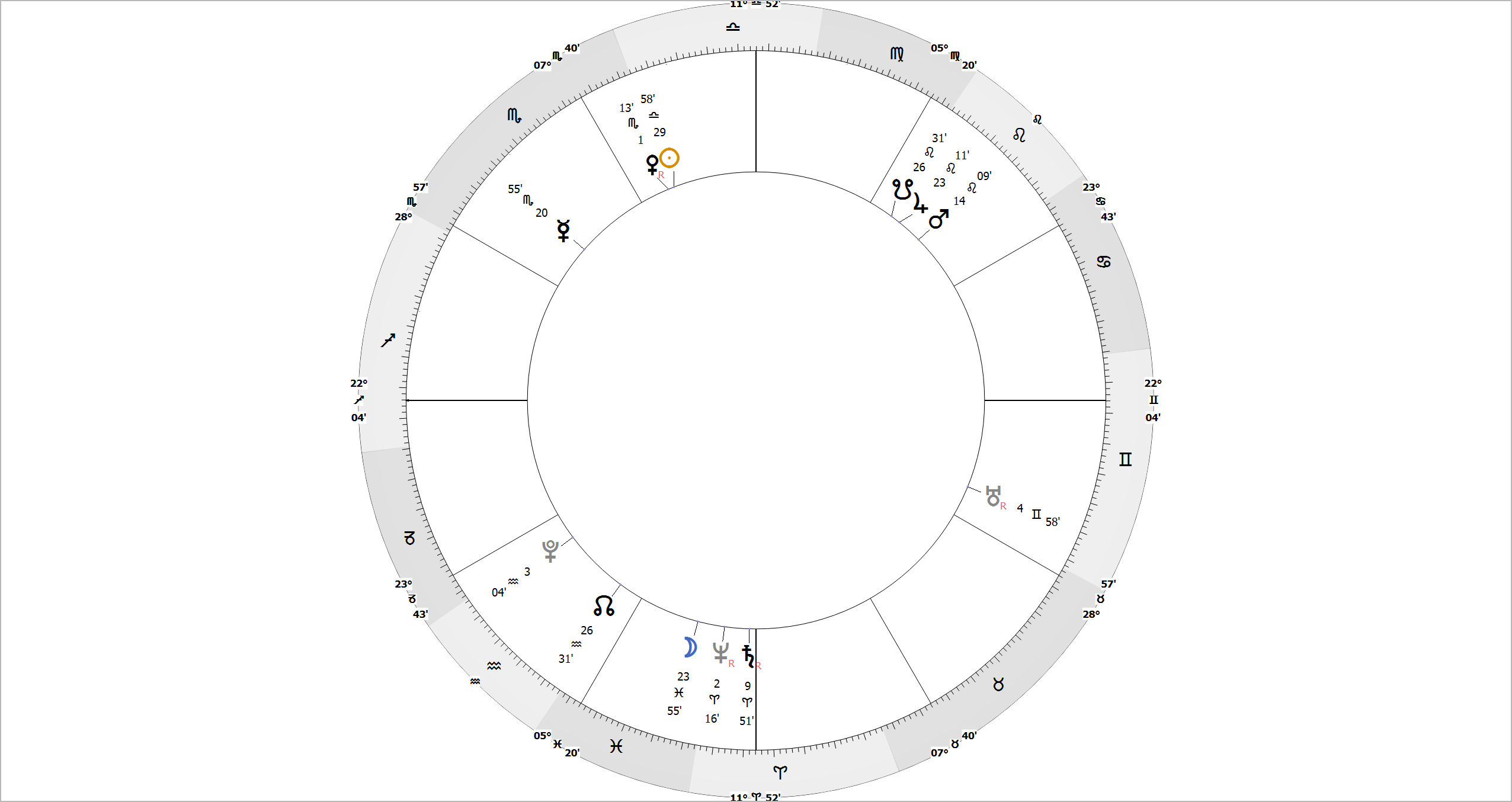
The querent’s body is signified by the Lord of the First House (L1), Jupiter in Leo. The fundamental diagnostic technique (although certain exceptions apply) involves comparing the elemental qualities of the planet signifying the body with those of the sign it occupies. When these qualities are incompatible, the body is considered to be in a state of imbalance.
In the case under examination, Jupiter is a hot and moist planet occupying Leo, a hot and dry sign. Consequently, the body is experiencing an imbalance.
The cause of this imbalance is revealed by the dispositor of L1, that is, the planet ruling the sign occupied by Jupiter. In this case, the dispositor is the Sun in Libra. The sign of Libra immediately indicates the underlying cause of the imbalance: an excess of the sanguine humour, which interferes with the flow of solar energy throughout the body.
Let us look at this more closely.
At a deeper level, the excess of the sanguine humour, which is the main imbalance that needs to be addressed, is associated with the qualities of heat and moisture. These qualities not only help explain the querent’s symptoms but also disturb the body’s natural vitality, symbolically represented by the Sun. In traditional humoral theory, moisture has the ability to bind and hold things together, while heat encourages activity, movement, and circulation. When these qualities become excessive, they disturb the body’s natural balance. From a traditional humoral perspective, this excess of heat and moisture may also be understood as creating favourable conditions for bugs to multiply and spread throughout the body. In this particular case, the excess moisture is reflected in the continuous nasal discharge, while the excess heat is understood to make these fluids thinner and encourage their movement and flow. Together, these two qualities provide a humoral explanation for the querent’s persistent runny nose. As long as this excess of the sanguine humour persists, the symptoms may continue, while the body’s natural vitality, represented by the Sun, remains disturbed.
One of the most valuable works in traditional medical astrology is Richard Saunders’ The Astrological Judgement and Practice of Physick, published in 1677. The book offers a detailed approach to medical diagnosis based on planetary positions and the principles of humoral medicine. Saunders explains how different planetary placements can indicate specific humoral imbalances, their associated symptoms, and the severity of an illness (in terms of four degrees). He also provides traditional remedies, particularly herbal preparations, intended to restore the body’s natural balance. His work remains an important historical reference for understanding the practical application of traditional medical astrology. Returning to our example, the Sun is positioned at 29° Libra, which falls within the last six degrees of the sign. According to Richard Saunders, this particular placement is moist in the 2nd degree and hot in the 3rd degree, producing illnesses associated with thin blood and thin yellow choler, with blood being the predominant humour. So, not a dangerous imbalance applying our logic.
Treatment: Restoring the Humoral Balance and Supporting the Sun
Following the principles of traditional medical astrology described by Oscar Hofman, the treatment would have two main objectives: reducing the excess of the sanguine humour and restoring the disturbed solar energy. The measures employed would depend on the severity of the condition, beginning with milder approaches before considering stronger remedies.
1. Reducing the excess of the sanguine humour
Since blood is naturally hot and moist, the traditional principle of antipathy suggests introducing the opposite qualities of coldness and dryness. This could be approached through foods such as barley, lentils, chicory, broccoli and sour fruits, which are traditionally considered cooling and drying. The purpose would be to counteract the excessive heat and moisture and gradually restore the humoral balance.
Lifestyle adjustments would also play an important role. In humoral theory, blood is associated with expansion, movement, stimulation and social activity. When present in excess, these tendencies must be moderated. Gentle physical exercise would provide an outlet for excessive activity, while sufficient rest and reduced mental and social stimulation would help calm the overactive sanguine temperament. Practical activities such as gardening would be particularly suitable because they bring the individual into direct contact with the Earth element, whose cold and dry qualities oppose the hot and moist nature of blood. Psychologically, discipline, moderation and a quieter daily routine would serve the same balancing purpose.
2. Supporting the weakened solar energy
The second objective would be to support the Sun, which, as the dispositor of L1, represents the planetary energy disturbed by the humoral excess. Within the traditional principle of sympathy, substances associated with a particular planet can to help restore its proper bodily function. Ruby, for example, is strongly associated with the Sun. It could therefore be considered as a traditional means of supporting the weakened solar energy, although the most suitable planetary remedy would depend on the complete horary judgment.
3. Choosing measures according to severity
In a mild condition, adjustments to diet, rest and daily activities would traditionally be the first measures considered. If the imbalance were more pronounced, herbs associated with reducing sanguine excess, such as plantain, shepherd’s purse or chicory, might be considered under qualified professional supervision. More serious or persistent symptoms would require medical assessment rather than reliance on stronger traditional remedies.
Medical Disclaimer:
Traditional medical astrology should never be used as a substitute for modern medicine or professional medical care. Any medical condition should first be assessed by a qualified healthcare professional. Medical astrology, if used, should serve only as a complementary approach, working alongside modern medicine and always under the guidance and supervision of a qualified medical practitioner. Herbal remedies should never be used without professional guidance, as some herbs may cause adverse effects, interact with medications, or be toxic.

