
In the autumn of 1957, in Plainfield, a small farming community in Wisconsin, the disappearance of a woman was about to uncover one of the most disturbing cases in American criminal history. The investigation led police to the isolated farmhouse of Edward “Ed” Gein, a lonely and eccentric man whom most locals considered rather harmless. What they discovered inside his home was far worse than anyone could have imagined: human remains, objects made from bones and skin, and evidence that he had been digging up bodies from nearby graves. Behind the ordinary life of a seemingly peaceful rural community lay a disturbing story of isolation, death, and a deeply troubled mind.
Gein’s story soon reached far beyond the world of true crime. In the years that followed, aspects of his personality and crimes inspired some of the most recognizable characters in horror cinema. From Norman Bates in Psycho to Leatherface in The Texas Chain Saw Massacre and Buffalo Bill in The Silence of the Lambs, traces of Gein can be found in several very different fictional killers. Leatherface, in particular, bears a striking resemblance to Gein through his use of masks made from human skin, reflecting some of the discoveries made at the Plainfield farmhouse. The real events, however, were quite different from the terrifying stories that Hollywood later created around them.
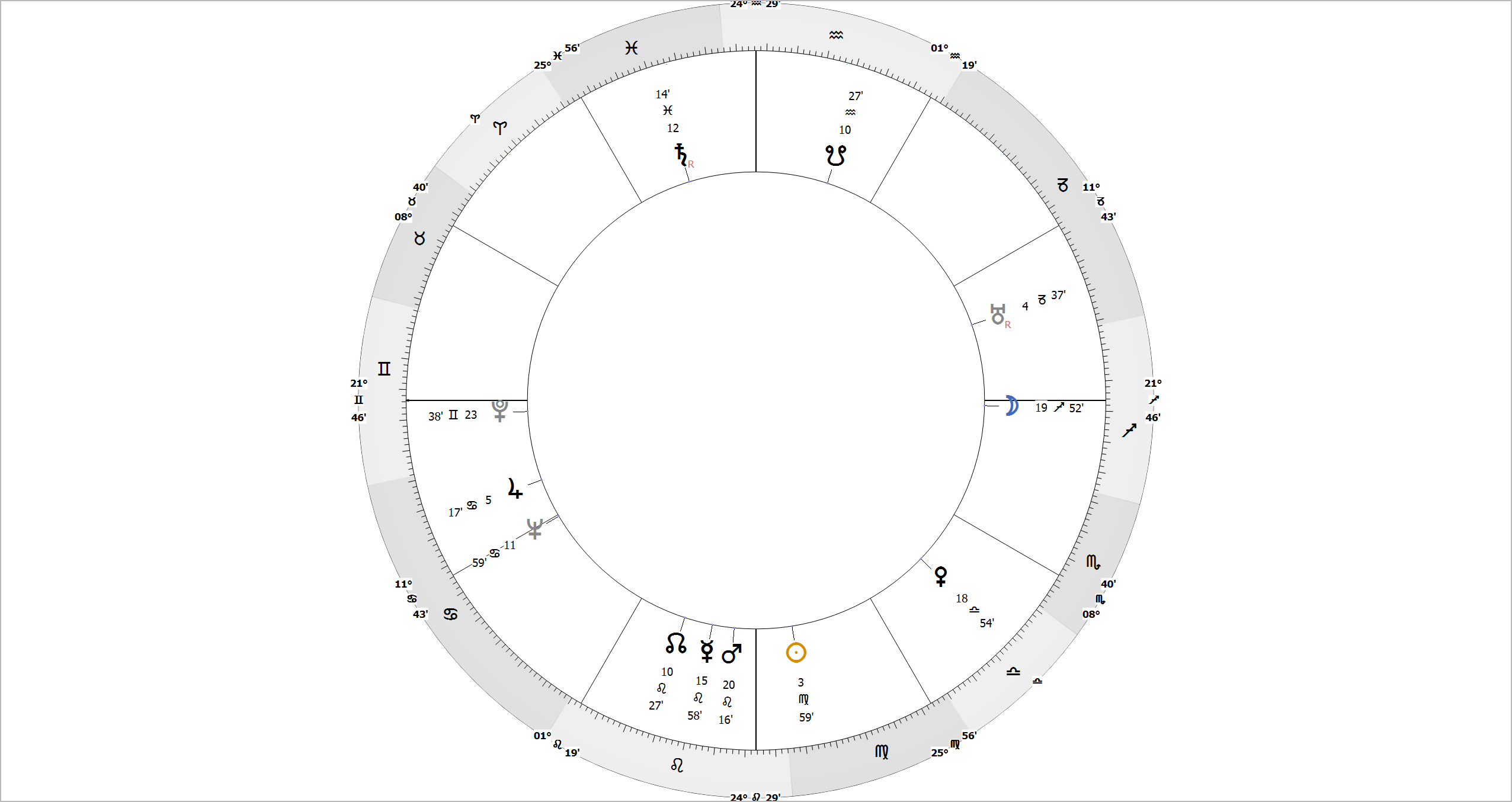
One of the most important aspects of Gein’s life was his unusual and deeply troubled relationship with his mother, Augusta. A strict and intensely religious woman, she raised her sons in isolation, teaching them to distrust the outside world and portraying women as sinful and morally corrupt. Gein developed a strong emotional dependence on her, which continued into adulthood. Her death in 1945 left him increasingly isolated, and his later actions have often been examined in connection with this attachment and his inability to come to terms with her loss. With this background in mind, we will examine Gein’s natal chart to explore this powerful maternal influence and the nature of their relationship. Below is Gein’s chart:
North La Crosse, Wisconsin
A Disturbing Saturnian Maternal Figure
One of the first things we notice in Ed Gein’s natal chart is the elevated position of Saturn. It is the only planet in the upper hemisphere of the chart, making its presence particularly prominent and giving it a special symbolic significance. Saturn, the planet of severity, restriction and rigidity, is the Lord of the 10th house, which represents Ed’s mother. As a result, his mother takes on particular importance in his life, with her presence strongly felt from this elevated position.
Saturn is peregrine and retrograde, expressing a particularly unpleasant side of the Greater Malefic. In this context, Saturn comes to represent maternal tyranny, oppression and narrow-mindedness, while its retrograde motion suggests a tendency to cling to the past and resist change. Gein’s mother is therefore portrayed in his natal chart as a difficult and oppressive presence. Saturn is on Achernar and the myth of Phaethon may also reflect the overwhelming influence of Gein’s mother, whose moral authority dominated his life. Much like Phaethon losing control of the solar chariot, her excessive control may have contributed to destructive consequences.
It is also worth noting that Saturn is the Lord of the 9th house of religion and the 8th house of death. This suggests that strict, outdated religious beliefs and death are closely connected with the figure of his mother. Religion (9th house) appears to be an area of Gein’s life that causes harm and restriction, as indicated by the South Node.
Receptions between planets reveal their motives and attitudes towards one another. In the case of Saturn, Lord of the 10th house and significator of Gein’s mother, and Mercury, Lord of the 1st house and significator of Gein himself, the receptions are particularly unpleasant. Mercury is in Saturn’s detriment, while Saturn is in both Mercury’s detriment and fall. This suggests a relationship that is harmful to both Gein and his mother. From the mother’s side, the reception by fall may also indicate a sense of disappointment in her son.
Venus, the planet of connection is the Lord of the 12th house in Gein’s natal chart, the house of the skeletons Ed keeps hidden in his closet. The 12th house represents the hidden monsters and “sins” of a person’s life. In Ed’s case, the monster seems to emerge through the 5th house of sexuality and creative expression. This is also closely connected with his mother (L10) and the essence of death (L8), since Venus is not only connected to Saturn by antiscion, but the two planets are also in each other’s exaltation, suggesting that they support and strengthen one another. This connection can be seen in Gein’s disturbing fascination with the female body (Venus), which became closely associated with his unresolved attachment to his mother (Saturn, L10) and continued even after her death. His exhumation and mutilation of female corpses, along with his creation of objects from human remains, offer a particularly dark expression of the connection between sexuality, distorted creativity and the maternal figure.
Finally, we notice the Moon, the planet of fluidity and changeability, positioned directly on the cusp of the 7th house, the house of other people. This suggests that Gein’s interactions with others are strongly influenced by the Moon, which is in a relatively weak condition. What makes this placement particularly interesting is that the conjunction of the Moon with the 7th-house cusp falls on the fixed star Rasalhague, the brightest star in the constellation of Ophiuchus, the Serpent Bearer. The image of Ophiuchus introduces the symbolism of the serpent, the struggle to control its dangerous power, and the possibility of healing and transformation. The serpent’s ability to shed its skin also represents renewal, the abandonment of an old form and the emergence of a new one. In Gein’s case, this symbolism may suggest that his relationships with others became a place where difficult emotional impulses and questions of control found expression.
The Moon’s influence on the 7th house may also reflect how he was perceived by others, bringing to mind the term “lunatic”, traditionally associated with madness and irrational behaviour. The symbolism becomes even more disturbing when we consider his obsession with human skin and his attempts to create a new identity through the remains of his victims. It is particularly important to note the connection between the Moon, representing emotions, and the equally weakened Mars, the traditional planet of aggression, conflict and tension, as well as the Lord of the 6th house of illness. This brings together the symbolism of emotional instability, aggression and illness, all expressed through the 7th house of relationships and interactions with others. We should also remember that the Moon is one of the natural significators of the mother in traditional astrology. This adds another layer to the interpretation, suggesting that Gein’s relationships with others may have been deeply influenced by his attachment to the maternal figure in his life who is, again, in a negative reception towards L1, Mercury, Gein.
The Skin
In traditional cosmology, the Earth stands at the centre of the universe, surrounded by seven planetary spheres. Saturn, the slowest and most distant of the visible planets, occupies the outermost sphere, marking the boundary between the planetary world and the realm of the fixed stars beyond. Saturn therefore represents limits, restriction and separation. In the human body, this same principle is expressed through the skin, which forms our outermost physical boundary, separating us from the external world while protecting us from its influences. This is why, in traditional medical astrology, the skin is ruled by Saturn.
This symbolism becomes particularly striking in Gein’s natal chart. Saturn is the only planet above the horizon, elevated in the 10th house and conjunct a first-magnitude fixed star, making its presence especially prominent. The 10th house represents not only the mother, whom Saturn signifies as its ruler, but also our public image, reputation and what we become known for in society. In Gein’s case, his disturbing use of human skin became one of the most notorious aspects of his crimes. It is therefore remarkable, from an astrological perspective, that Saturn, the traditional ruler of the skin, occupies such a prominent position in the very house of public reputation.