Hypericum perforatum, commonly known as St. John’s Wort, has occupied an important place in traditional medicine for centuries. Its long history can be traced through European herbal traditions, where it was valued for its medicinal properties and its symbolic significance. Beyond its practical applications, the herb became closely associated with beliefs concerning nature, healing, and the relationship between the terrestrial and celestial worlds.
The common name St. John’s Wort derives from the plant’s traditional association with St. John the Baptist, whose feast day is celebrated on June 24, shortly after the summer solstice. As the herb typically begins flowering around this period, it became closely connected with midsummer celebrations, when the days are at their longest and the Sun reaches its greatest annual height in the Northern Hemisphere.
This seasonal association provides an initial indication of the plant’s solar character, which becomes even more apparent when examining its physical appearance.
The Solar Signature
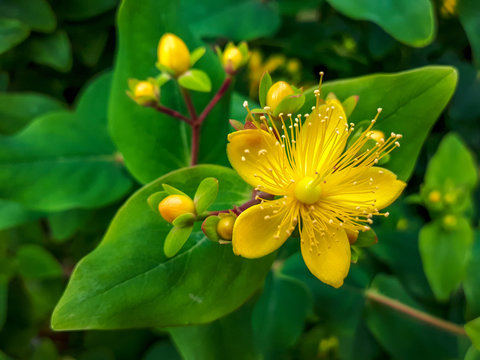
The solar nature of St. John’s Wort (Hypericum perforatum) is particularly evident in its flowers, whose brilliant golden-yellow colour evokes the warmth and radiance of the Sun. Each flower bears five delicate petals surrounding numerous fine yellow stamens that extend outward like rays of sunlight. This arrangement recalls the traditional astrological symbol of the Sun (☉), a circle with a central point representing the source of life, unity, and creative power. Just as the Sun occupies the centre of its planetary system, the flower’s structure suggests a central source from which energy radiates outward.
In traditional astrology, the Sun is associated with heat, dryness, vitality, illumination, and the life-giving principle. The Sun also signifies the heart, strength, authority, and the organizing power that holds individual parts together as a unified whole. These qualities find a symbolic expression in the flower’s golden colour, radiant form, and harmonious arrangement. Its many stamens, emerging from a common central region, can be interpreted as an image of the solar principle: a single source expressing its power through multiple rays while maintaining its essential unity.
Further solar signatures appear in the plant’s seasonal development and distinctive features. St. John’s Wort flowers around midsummer, when daylight reaches its greatest duration in the Northern Hemisphere, strengthening its traditional association with solar abundance and vitality. Its leaves contain numerous translucent glands that, when held against the light, appear as tiny luminous points, resembling the countless stars—each a distant sun—scattered across the night sky. Meanwhile, its flowers and buds release a reddish pigment when crushed, recalling the fiery colours of the Sun. Within the traditional doctrine of signatures, these characteristics reinforce the plant’s correspondence with the Sun and its symbolic qualities of warmth, illumination, strength, and renewal.
A Solar Herb Against Darkness and Evil
The solar character of St. John’s Wort is further reflected in its longstanding reputation as a protective herb. Throughout European folklore, it was traditionally hung above doors and windows or carried as a charm to ward off evil spirits, witchcraft, and the evil eye. These customs were particularly associated with midsummer and the feast of St. John the Baptist, strengthening the plant’s connection with the Sun and its seasonal power.
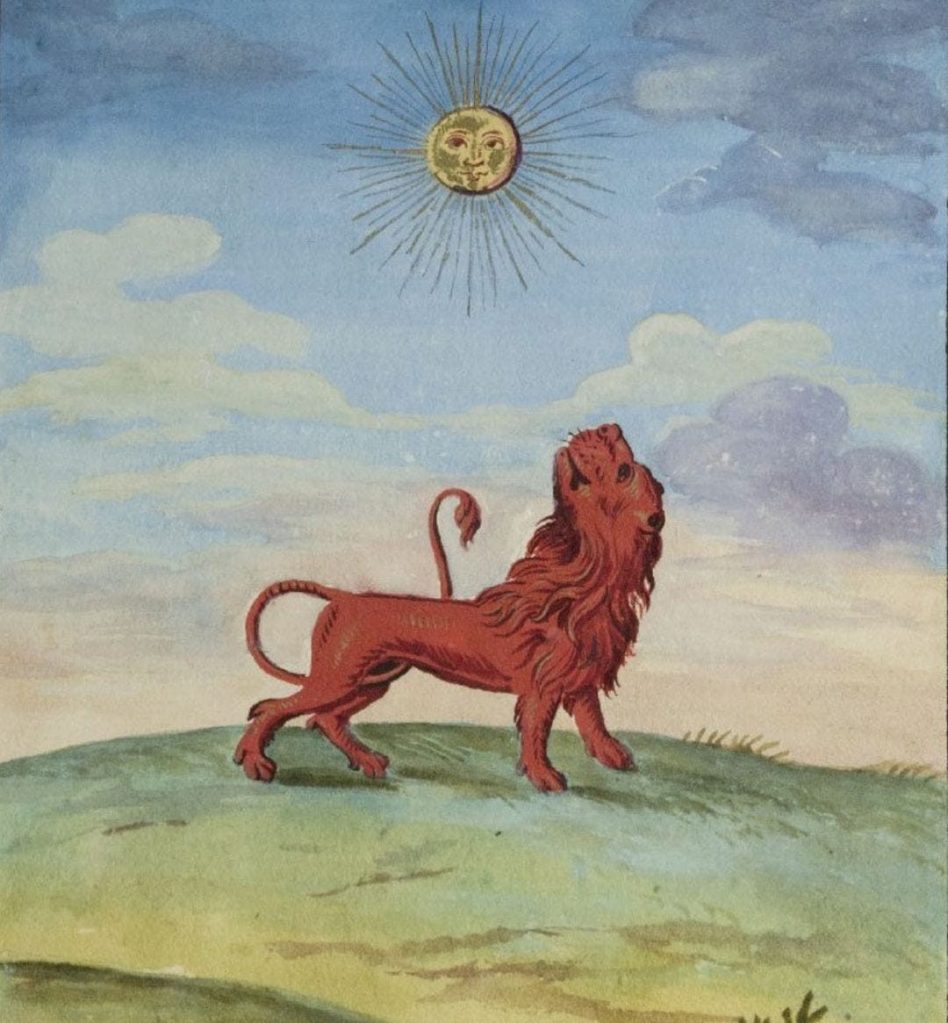
Its astrological rulership was explicitly recognized by Nicholas Culpeper (1616–1654), one of the most influential English herbalists and practitioners of traditional medical astrology. In his Complete Herbal, he placed St. John’s Wort under the sign of Leo and the dominion of the Sun, confirming its place within the traditional system of planetary correspondences.
This association acquires a deeper significance when considered alongside Christian symbolism, in which the Sun may serve as a visible image of divine light, reflecting God’s goodness, authority, and life-giving power. Just as the rising Sun dispels the darkness of night, divine illumination symbolizes the triumph of goodness over evil and truth over ignorance. Light reveals what darkness conceals, bringing clarity, order, and the promise of renewed life.
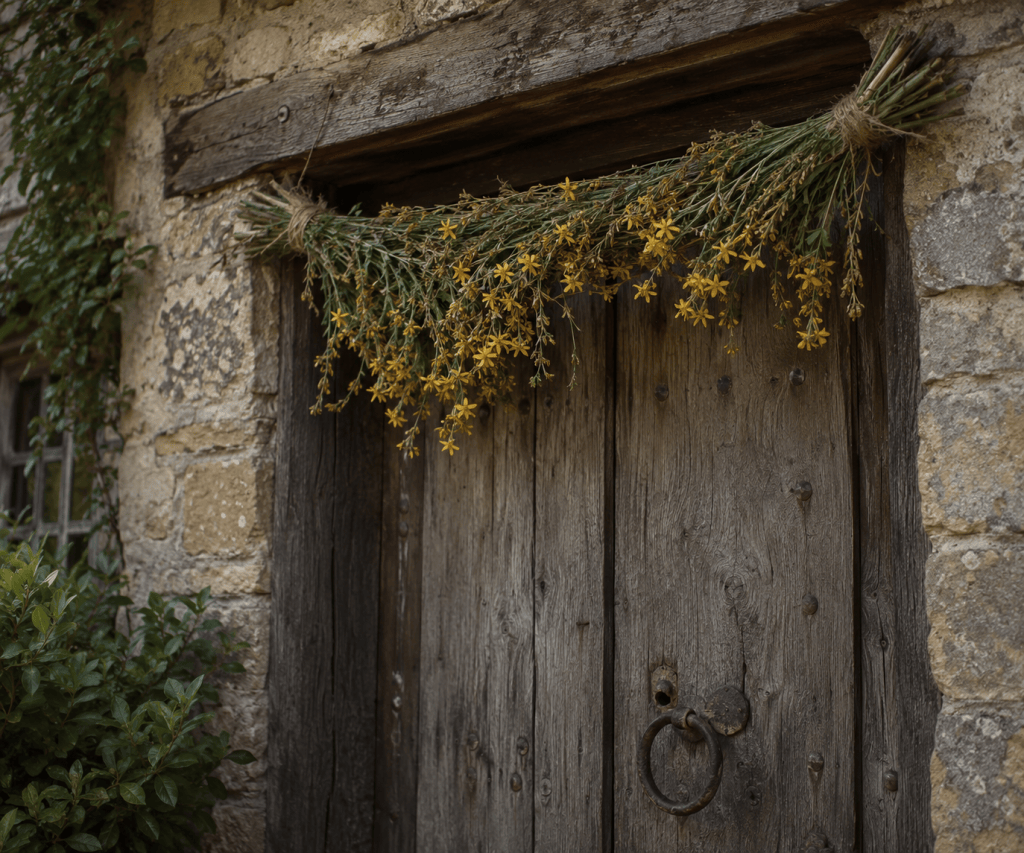
From this perspective, the traditional belief that St. John’s Wort protects against harmful spiritual influences may be understood as an expression of its solar nature. The herb appears as an earthly reflection of the Sun’s illuminating and protective power, bringing together the symbolism of midsummer, Christian beliefs, and ancient European folklore.
The Medicinal Temperament of St. John’s Wort
The solar signature of St. John’s Wort extends beyond its appearance and folkloric reputation into the domain of traditional medicine. According to Avicenna, the renowned Persian physician and author of The Canon of Medicine, the herb possesses a hot and dry temperament, qualities traditionally associated with the Sun. Heat symbolizes vitality, movement, activity, and the power to stimulate, while dryness represents firmness, consolidation, and the ability to disperse excessive moisture. Together, these qualities express an active and transformative influence, traditionally understood as capable of counteracting stagnation and restoring balance. Such qualities also provide a foundation for examining the herb’s medicinal applications through traditional astrological principles.
In traditional medical astrology, herbs are associated with particular planets according to their perceived qualities and characteristics, while the principles of sympathy and antipathy help explain how these planetary correspondences are applied in healing. Sympathy describes a harmonious relationship between planetary influences, through which one may support or strengthen another. Antipathy, by contrast, concerns opposing qualities, whereby one influence may counteract the excess of another. These principles offer a framework for understanding the traditional medicinal applications of St. John’s Wort in relation to its solar rulership and its connections with Saturn, Mars, and the Moon.
The Sun and Saturn: Melancholy and Depression
One of the best-known applications of St. John’s Wort concerns depressive and melancholic conditions, traditionally associated with Saturn.
As the planet governing restriction, isolation, darkness, and melancholy, Saturn stands in symbolic contrast to the Sun, which represents illumination, vitality, and the life-giving spirit. Here, St. John’s Wort may be understood as working through antipathy, its solar influence opposing the heaviness and withdrawal characteristic of melancholy. The traditional symbolism becomes particularly interesting when considered in relation to the humoral understanding of melancholy as an excess of black bile, a condition also discussed by Avicenna in connection with the herb. Within this framework, the Sun represents an influence capable of opposing Saturnian coldness and restoring the vitality diminished by melancholy. The medicinal reputation of St. John’s Wort thus offers a symbolic parallel to the solar principle of illumination overcoming darkness.
The Sun and Mars: Wounds and Healing
Another important application concerns wound healing, particularly injuries, cuts, burns, and bruises. Such conditions belong principally to Mars, the planet associated with blood, sharp instruments, wounds, and physical injury. In this case, the relationship operates through sympathy rather than antipathy. The Sun is exalted in Aries, the fiery domicile of Mars, establishing a special relationship between the two planets. From this perspective, the solar influence may be interpreted as supporting the restoration of tissues affected by martial injuries. The herb’s longstanding reputation as a wound remedy, acknowledged by both Avicenna and Culpeper, provides an interesting example of this planetary relationship.
Its traditional application to the skin also introduces a secondary Saturnian association, since Saturn governs the body’s protective boundaries. Thus, the herb’s wound-healing symbolism brings together the martial nature of injury, the Saturnian nature of the skin, and the restorative principle attributed to the Sun.
The Sun and the Moon: Menstruation and Bodily Fluids
St. John’s Wort was also traditionally employed to promote menstrual flow, an application that may be considered in relation to the Moon. In traditional astrology, the Moon governs bodily fluids, fertility, and the menstrual cycle. Its receptive and moist nature contrasts with the active and warming influence of the Sun. Within the framework of humoral medicine, menstrual obstruction was sometimes attributed to excessive coldness or stagnation, conditions that warming herbs were believed to relieve. The traditional use of St. John’s Wort may therefore be interpreted through antipathy, with solar warmth counteracting an excess of lunar coldness and encouraging the restoration of natural movement. This relationship does not suggest an inherent hostility between the Sun and Moon, but rather illustrates how their contrasting qualities might be understood as complementary or corrective, depending on the nature of the imbalance.
Conclusion: The Sun Reflected in Nature
Taken together, the botanical characteristics, folkloric traditions, and medicinal associations of St. John’s Wort reveal a consistent pattern of solar symbolism. Its golden flowers reflect the radiance of the Sun, its translucent leaves evoke the celestial heavens, and its protective reputation recalls the traditional image of light overcoming darkness. These associations extend into medical astrology, where the herb’s applications may be interpreted through the complementary principles of sympathy and antipathy. St. John’s Wort therefore provides a particularly interesting example of the traditional doctrine of signatures, in which the visible characteristics and reputed properties of a plant are understood as expressions of a greater celestial principle. From this perspective, the herb represents not simply a plant governed by the Sun, but a natural manifestation of the qualities traditionally attributed to it: unity, illumination, vitality, and restoration.

